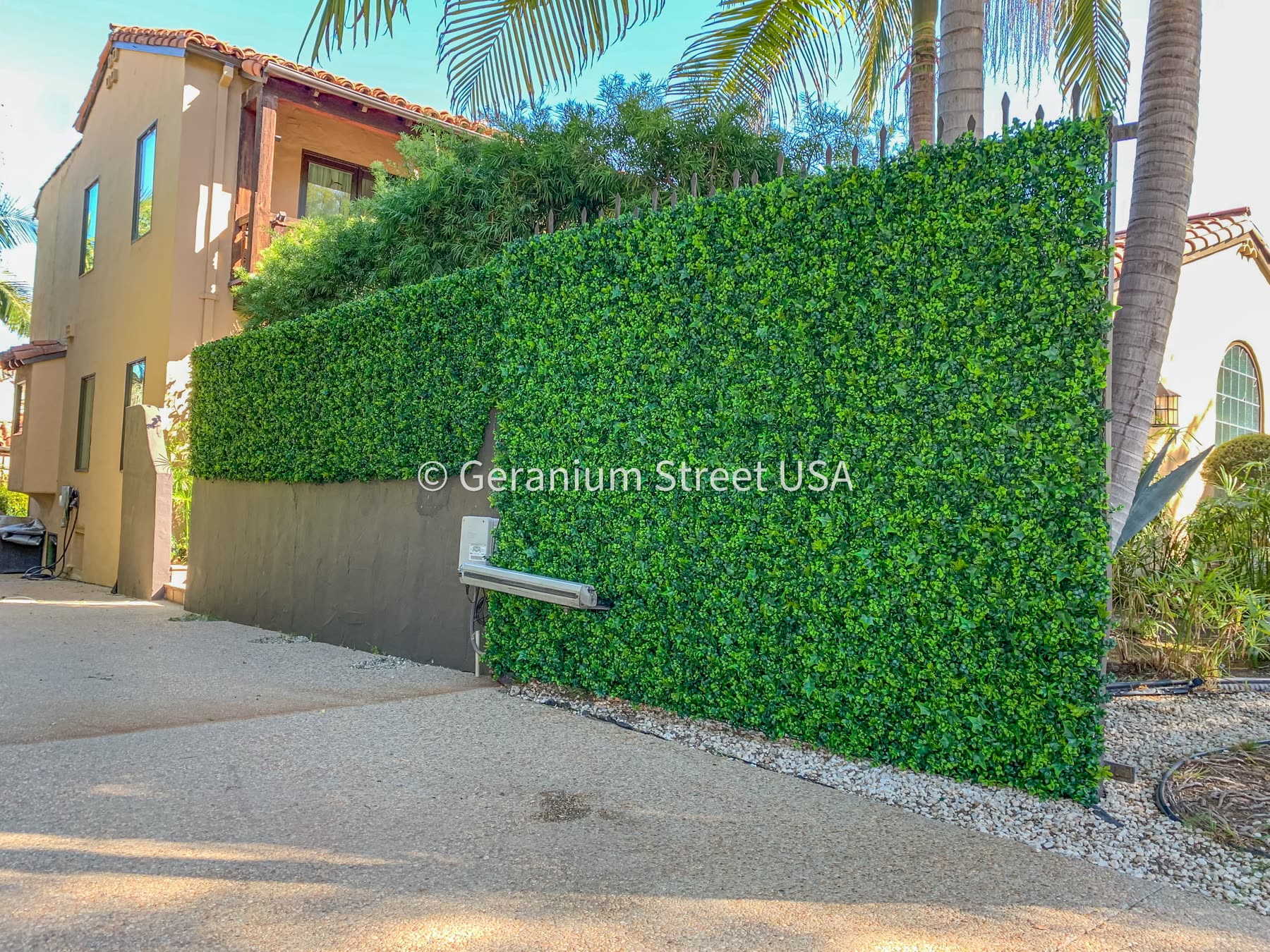
Green wall maintenance in Texas: quick answer
If you searched for "green wall maintenance Texas," "green wall maintenance Dallas TX," or "green living wall maintenance in Fort Worth, TX," this page is for two situations: a live wall is already struggling, or you are trying to understand the maintenance commitment before installing one.
This guide covers routine tasks, source-linked cost and water benchmarks, Texas-specific failure points, and when an artificial wall may be a practical alternative.
Planning a similar project? See artificial living wall installs → and the Dallas city page.
What living green wall maintenance involves
Planning a similar project?
Use these next pages while you read
They cover pricing, service details, and the next planning step without making you leave the article blind.
A living wall is not a garden rotated 90 degrees. Water doesn't pool, gravity pulls nutrients downward, roots are confined to shallow pockets or felt, and every plant sits in a slightly different microclimate depending on its position on the wall.
That means maintenance isn't just "water it and trim it." Here's what a typical schedule looks like:
- Inspect irrigation system for clogged emitters, leaks, and dry zones
- Check for pest and disease issues (fungal problems are common in Houston humidity)
- Remove dead or dying plant material before it spreads to neighbors
- Monitor moisture levels across different zones of the wall
- Fertilization (liquid through irrigation or manual application)
- Prune overgrowth to maintain the intended design
- Replace any plants that have died or are declining
- Clean the wall face and any visible hardware
- Major pruning pass
- Irrigation system flush and recalibration
- Replace growing media (annually for exterior walls, per LiveWall documentation)
- Heat-season or winterization adjustments
Most professional providers recommend biweekly visits during the first few months while irrigation timing is dialed in, then monthly after that.
What it costs
for a 100 sq ft wall (high end)
(south-facing, hot climate)
(worst case)
Professional maintenance labor: Published and vendor-facing estimates commonly put living wall maintenance around $1.50 to $3.00 per square foot per month. For a 100 square foot living wall, that works out to $150 to $300/month, or $1,800 to $3,600 per year before repairs or access equipment. Treat that as an educational benchmark, not a quote.
Plant replacements: Even well-designed systems can lose plants. Published replacement rates range from 2% per year on high-end modular systems up to 12% per year in challenging climates. In Texas, the issue is usually heat stress, UV damage, and irrigation failure during peak summer.
Water: Published research from a multi-year study monitoring 16 living walls found annual water consumption of 200 to 500 liters per square meter per year. That works out to roughly 5 to 12 gallons per square foot per year. South-facing walls in hot climates consume up to three times more than shaded walls. In Texas, where the TWDB has documented that about 31% of residential water use already goes to outdoor purposes, adding a living wall adds to an already significant water bill.
What goes wrong in Texas specifically
Texas isn't gentle on living walls. Here's what makes maintenance harder here compared to milder climates:
The honest comparison: living wall vs. artificial wall
| Living Green Wall | Artificial Green Wall | |
|---|---|---|
| Annual maintenance (100 sq ft) | $1,800 – $3,600+ | Low routine upkeep (occasional rinse) |
| Water use | 5–12 gal / sq ft / year | No irrigation water |
| Plant replacement | 2–12% annually | No live plants to replace |
| Irrigation system | Required, needs monitoring | No irrigation system |
| Fertilization | Monthly | No fertilizing |
| Pruning | Biweekly to monthly | No pruning |
| Professional visits | Monthly minimum | Not typically required for plant care |
| Appearance in August | Depends on maintenance | More consistent with cleaning |
An artificial wall is not no-cost. The upfront cost is real, but routine upkeep is usually lighter after installation. A rinse with a hose once or twice a year to clear dust is the standard recommendation.
When a living wall makes sense anyway
We're not going to pretend artificial is right for every project. A living green wall makes sense when:
- You have a dedicated maintenance budget and contract already in place
- The wall is interior with controlled climate (offices, lobbies, atriums)
- You want the air quality and biophilic benefits that come from real plants
- The space has good access for maintenance (not a 30-foot exterior wall)
- You have reliable water supply not subject to seasonal restrictions
If those conditions are met, a well-maintained living wall can be a strong choice.
When artificial is the practical choice
An artificial green wall can be the better fit when:
- The wall is exterior in full Texas sun
- There's no irrigation infrastructure and adding one isn't practical
- The property is in an area with water restrictions or drought risk
- Ongoing maintenance budget is limited
- The wall needs to look consistent year-round for commercial or HOA purposes
- You want green at a pool, patio, or fence line without irrigation near water features
For properties in Dallas, Fort Worth, Houston, and San Antonio, artificial walls are often considered once the maintenance requirements of live walls become clear.
If you're already maintaining a living wall and it's struggling
Before you rip it out, check these common issues:
Sources
Data referenced in this article:
See our artificial living walls page to compare options, or explore installations in Dallas, Fort Worth, Houston, and San Antonio.
Need a next step?
Planning a similar Texas project?
Use this article for research, then send your dimensions, city, and photos if you want a useful next step.
Ready for the next step?
Use the page that fits your project best
Pick the shortest path based on whether you need pricing, a service page, or a local planning page.